
Cancer, pollution and the food chain
There was a time when #Cancer was a rare disease. Not anymore!!
Almost every family today knows someone who has battled it, some survived, others weren’t as lucky.
While medical science has made it easier to diagnose, we as a nation must ask ourselves -
👉 Why is this once-rare disease becoming so common?
In the name of 'development' and 'profits', we’ve damaged our basic ecosystems:
- Overuse of fertilizers and pesticides has poisoned our #FoodChain.
- Air and water #pollution have forced us to buy purifiers just to breathe and drink safely.
- And every year, despite endless debates, nothing really changes.
Look at #Delhi’s air pollution - same story every year.
Politicians make noise, citizens suffer, and strong measures never materialize.
A few #facebook groups I am part of, people mostly discuss how to clean vegetables properly, or whether it’s safe to eat fish anymore, what other precautions can be taken to avoid this dreadful disease!
💰 Then comes the financial burden.
With government hospitals overburdened, most patients turn to private healthcare, where treatment can easily costs over ₹5 lakhs!
For millions, that’s enough to push them into poverty.
Worse, unless one has a specific cancer-care add-on, most #insurance policies hardly help, thanks to their complex exclusions.
Some eye-opening facts:
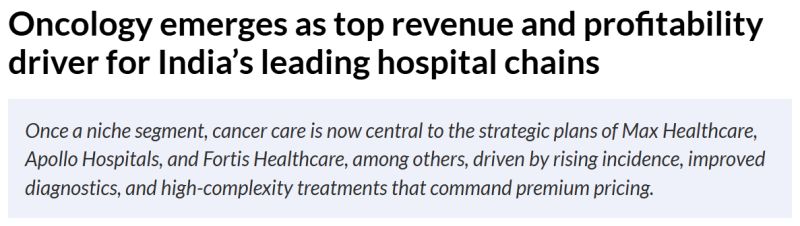
- Max Healthcare: #Oncology now contributes ~25% of inpatient revenue.
- Fortis Healthcare: Oncology revenue up 28% YoY in Q1 FY26, forming 16.4% of total hospital income.
- Apollo Hospitals: Oncology is the second-largest revenue contributor with 17% share.
As per the National Cancer Registry Programme (ICMR-NCDIR):
- India reported 13.9 lakh cancer cases in 2020.
- Expected to rise to 15.7 lakh by 2025, a 6.8% CAGR.
- Experts say the real incidence may be 1.5x–3x higher, due to underdiagnosis and incomplete data.
- In men, head & neck, gastrointestinal, and lung cancers dominate.
- In women, breast, cervical, and GI cancers are most common.
Cancer isn’t just a medical problem. It’s an environmental, policy, and lifestyle crisis.
Until we start fixing what’s 'causing' it, not just what’s detecting it, the “fight against cancer” will remain an endless battle.