
Why you can't invest 90% of your salary, and that's fine
“I can't even invest 25% of my salary. And she is investing 90%!”
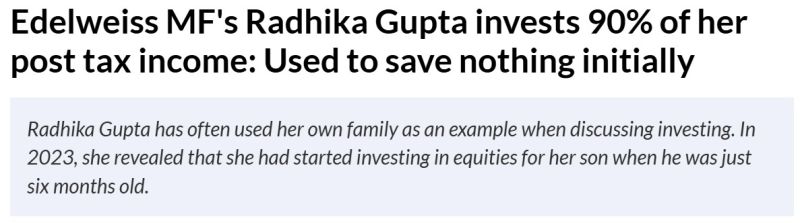
A friend sent me this message after reading about Radhika Gupta investing 90% of her post-tax income.
I had to explain:
She earns in crores.
Even 10% of her income could potentially be more than your entire take-home salary.
So why compare?
Everyone has a different starting point, income, and lifestyle.
But he was adamant.
“I want to increase my investment rate. Can you help?”
So we sat down and looked at his expenses.
The problem was obvious. Lifestyle inflation!
Every increment had increased his spending, not his investment rate.
📱 Gadgets upgraded almost every year.
🍽️ Eating out had become routine.
✈️ International vacations had become an expectation.
📦 E-commerce orders had become almost effortless.
There was no real visibility on where the money was going.
That's when I introduced him to the concept of Minimalism at a very high level.
Not “stop spending and live like a monk.”
Rather:
Spend consciously. Buy what you genuinely value. Cut what you don't.
Use the gadget for another year.
Eat out a little less.
Buy something new only when you're ready to let go of something old.
Going through these expenses showed that he could potentially move from a 25% investment rate to around 40%.
He was excited.
“I'll start investing 40% from this month!”
I had to stop him.
A knee-jerk financial decision can hurt more than it helps.
Cutting expenses isn't just a mathematical exercise.
It's a behavioural change.
So we agreed on 30% to start with.
And no change to that number for the next 3 months.
Then reassess.
Because personal finance isn't about winning a savings-rate competition.
It's about building a lifestyle where your spending, investing, and priorities are actually aligned.
Don't copy someone else's 90%.
First, understand your own 25%.
Then find the money hidden inside it.
That's where Money Minus Noise begins.
If you feel your income has grown but your investments haven't grown at the same pace, let's identify where the money is actually going.