
Retiring with ₹2–3 crore? It's less than it sounds
Recently, a connection on LinkedIn asked me: “What would you recommend for someone retiring with a ₹2–3 Cr corpus?”
At first glance, ₹2–3 Cr sounds like a huge amount.
But for a retired couple spending around ₹1 lakh/month: The focus should shift from wealth creation to wealth preservation!
Because post-#retirement, running out of money hurts far more than missing extra returns!
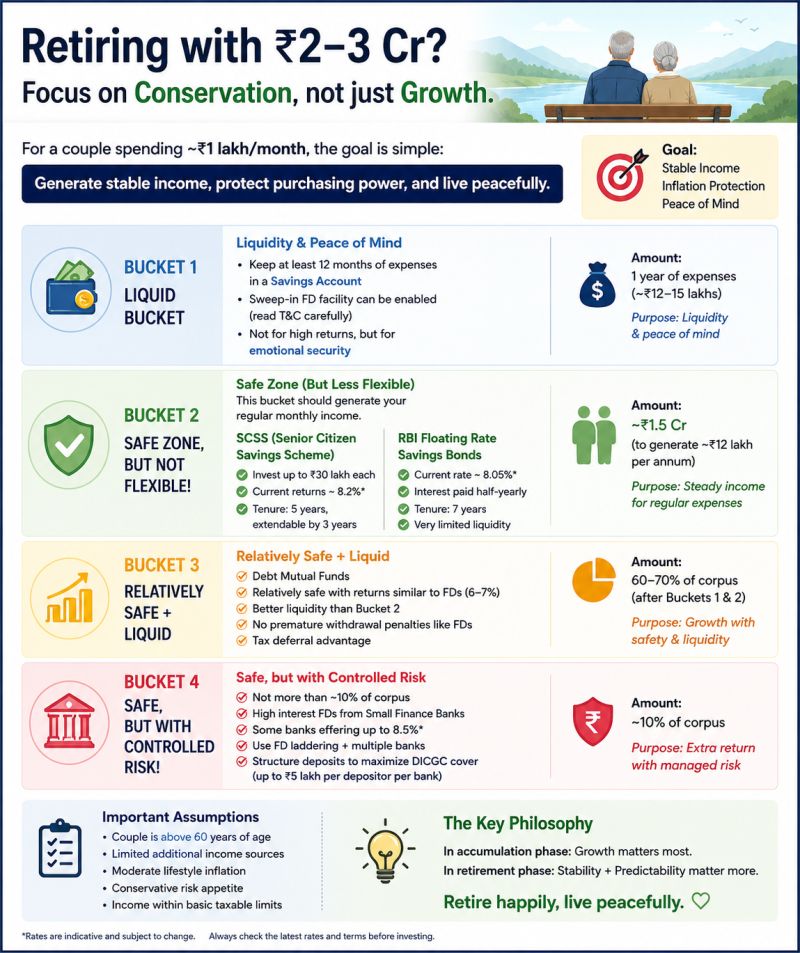
Here’s a simple bucket-based approach I would consider for someone above 60 years of age.
Bucket 1 - Liquidity & Peace of Mind
Keep: At least 12 months of expenses in a #SavingsAccount
A sweep-in FD facility can be enabled for slightly better returns, but read the fine print carefully.
This bucket is not about maximizing returns. It is about emotional comfort.
In retirement, liquidity itself becomes a return.
Bucket 2 - Safe Zone (But Less Flexible)
This bucket should ideally generate the regular monthly income.
#SCSS (Senior Citizen Savings Scheme)
A couple can invest: ₹30 lakh each, with current returns of 8.2% and a Tenure of 5 years, extendable by 3 years
#RBI Floating Rate Savings Bonds
Current rate 8.05%, Interest paid Half-yearly, and a Tenure of 7 years
Liquidity is extremely limited for this bucket!
For someone needing roughly ₹12 lakh/year, this bucket itself may require ~₹1.5 Cr allocation.
Bucket 3 - Relatively Safe + Liquid
Once regular income is secured, Debt #MutualFunds become useful.
Benefits:
- Better liquidity than SCSS/RBI Bonds
- No premature withdrawal penalties like FDs
- Tax deferral advantage
Returns may broadly range around FD-like levels over time.
This bucket focuses on providing liquidity in case of any urgent expenses, in a more tax-efficient manner.
Bucket 4 - Controlled Risk Bucket
Not more than ~10% of the corpus
Can be allocated to: #SmallFinanceBank FDs
Some currently offer: 8–8.5% interest rates!
But: Don’t chase returns blindly.
Through intelligent structuring, a couple can safeguard up to ₹20 lakhs corpus in a bank!
The target is to keep Bucket 1 always full, and this would be achieved by returns from other buckets. Bucket 4 is designed to dry up first, so don't worry too much about it. Also, the strategy needs a regular review, as this is due to changes in expenses, taxation, and the introduction of new schemes by the government.
A retirement portfolio should primarily do 3 things:
- Generate stable income
- Protect purchasing power
- Help you sleep peacefully
Do not try to outperform your neighbour’s portfolio, so stop comparing and also try to find the next 'star', when your corpus is limited 😄
Important Assumptions -
- The couple is above 60
- Limited additional income sources
- Moderate lifestyle inflation
If rental income, pensions, business income, or dependents are involved, the allocation strategy changes completely.
How would you structure a ₹2–3 Cr retirement corpus differently?
If you are looking for any advice on #PersonalFinance, #Taxation, #CreditCards, feel free to reach out!